
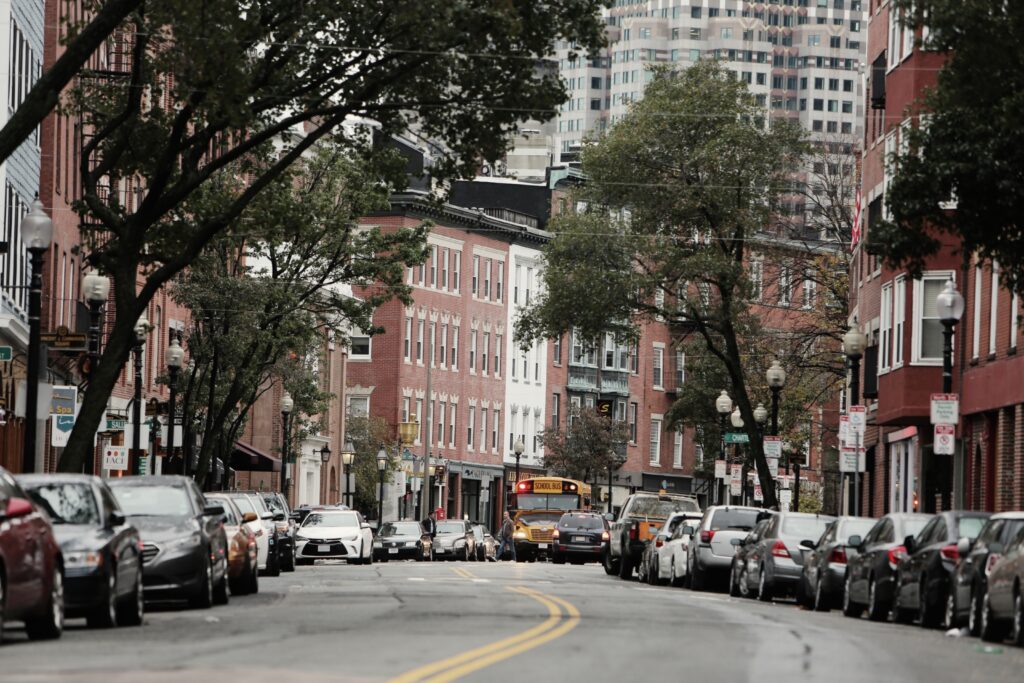
Every year, the end of August brings a familiar sight to Boston: moving trucks lining the streets, boxes stacked on sidewalks and thousands of students arriving for a new academic year.
BTI has engineered four decades of moves throughout New England since 1943. We know that a successful Boston move takes more than packing a truck—it takes careful planning, local knowledge and good timing.
Whether you are moving into a dorm, renting your first apartment or helping a student relocate from across the country, here are 10 facts worth knowing before move-in day.
1. Boston’s colleges enroll approximately 160,000 students
Boston’s colleges and universities enrolled 159,720 undergraduate and graduate students in 2022. That is a substantial population for a city of fewer than 700,000 residents.
Interestingly, not every enrolled student lives within the city limits. But that 160,000 number helps explain why streets, loading areas and apartment buildings become especially busy as the fall semester approaches.
2. College enrollment is equivalent to nearly one-quarter of the city’s population
Boston’s estimated population was 672,973 in 2025. Compared with the city’s college enrollment, that works out to roughly one student for every four Boston residents.
3. More than four in 10 students are in advanced-degree programs
The typical college move is not always a freshman heading into a dorm. In 2022, 58.8 percent of Boston students were enrolled in undergraduate programs, while 41.2 percent were studying beyond the bachelor’s-degree level.
Graduate, medical and law students are more likely to arrange their own housing, which means many are moving into private apartments rather than university residences.
4. Graduate enrollment has grown much faster than undergraduate enrollment
Between 2013 and 2021, undergraduate enrollment at the institutions tracked by the City of Boston declined by approximately 1 percent. Graduate enrollment increased by more than 18 percent during the same period.
That difference matters on moving day. Graduate students generally have less access to campus housing and are more likely to need professional help moving into apartments throughout Boston and the surrounding communities.
5. Many Boston students live outside Boston
Of the 153,220 students tracked in the city’s 2021 housing report, 83,391 were reported as living within Boston. Others lived elsewhere in Greater Boston, commuted from home, studied abroad or participated in co-op programs.
For families planning a move, it is important to think beyond the school’s name. A student attending a Boston institution may actually be moving to Brookline, Cambridge, Somerville, Newton or another nearby community. Each location presents different parking, building-access and scheduling considerations.
6. Fewer than half of Boston’s resident students are housed by their schools
In 2021, 46.9 percent of students living in Boston resided in dorms or other university-provided housing. Another 12.5 percent lived at home, while 40.5 percent—nearly 34,000 students—lived independently in off-campus housing.
An off-campus move often involves challenges that a dorm move does not: narrow staircases, limited elevator access, older buildings, restricted loading areas and tight move-in windows. Confirming these details in advance can prevent costly delays.
7. Graduate students are much more likely to live off campus
Approximately 63 percent of undergraduates living in Boston were housed by their schools in 2021. For graduate students, the figure was only 10 percent.
If you are entering an advanced-degree program, it is wise to begin planning early. Apartment availability, professional moving schedules and temporary storage options can become limited as September 1 approaches.
8. Most off-campus students are concentrated in a handful of neighborhoods
Approximately 66 percent of Boston’s off-campus students were concentrated in Allston, Brighton, Fenway and Mission Hill, according to the city’s 2021 report.
These neighborhoods are convenient to campuses and public transportation, but they also experience some of the heaviest move-in traffic. Parking plans, building rules and arrival times should be confirmed well before the truck is loaded.
9. Boston’s student moving period affects the entire city
In August 2025, Boston issued more than 4,500 moving-truck permits. More than 2,500 of those permits covered the especially busy period from August 29 through September 1.
The city also introduced temporary parking restrictions and paused certain construction permits in heavily affected neighborhoods. Students and parents should never assume that a truck can simply pull up outside an apartment on moving day. Check posted restrictions and arrange any necessary parking or street-occupancy permits in advance.
10. Boston’s student moves do not all fit in one truck—or even one day
Some students arrive with little more than clothing and a laptop. Others bring bedroom furniture, musical instruments, laboratory equipment or the contents of an entire apartment. International and long-distance students may also need storage between leases or while waiting for housing to become available.
The right moving plan depends on the student, the building and the destination. An accurate inventory, confirmed access instructions and realistic scheduling are more valuable than a one-size-fits-all checklist.
Plan Your Boston college Move Early
Boston’s college move-in period is exciting, but it is also one of the most demanding times of the year to relocate. Streets are crowded, elevators are booked and thousands of leases turn over at nearly the same time.
BTI provides local and long-distance residential moving, professional packing and secure storage solutions. Our experienced team can help coordinate the details and build a moving plan around your schedule, building requirements and destination.
Planning a college move to Boston or elsewhere in New England? Contact BTI to discuss your relocation and request an estimate.